Diyanet Center of America Wedding Photography Guide

Updated: 3 days ago

A Diyanet Center of America wedding needs a photography plan that respects the ceremony and makes room for the people around it. Start by confirming your Nikah arrangements and photography access with the center. Then build your portrait schedule around the space you can use, your family, and the light on the day.
The Diyanet Center of America is in Lanham, Maryland, at 9610 Good Luck Road, rather than within Washington, DC. Its official contact page lists 301-459-9589. Use that address for your travel plans, and give guests the location of your specific ceremony or meeting point once the center confirms it.
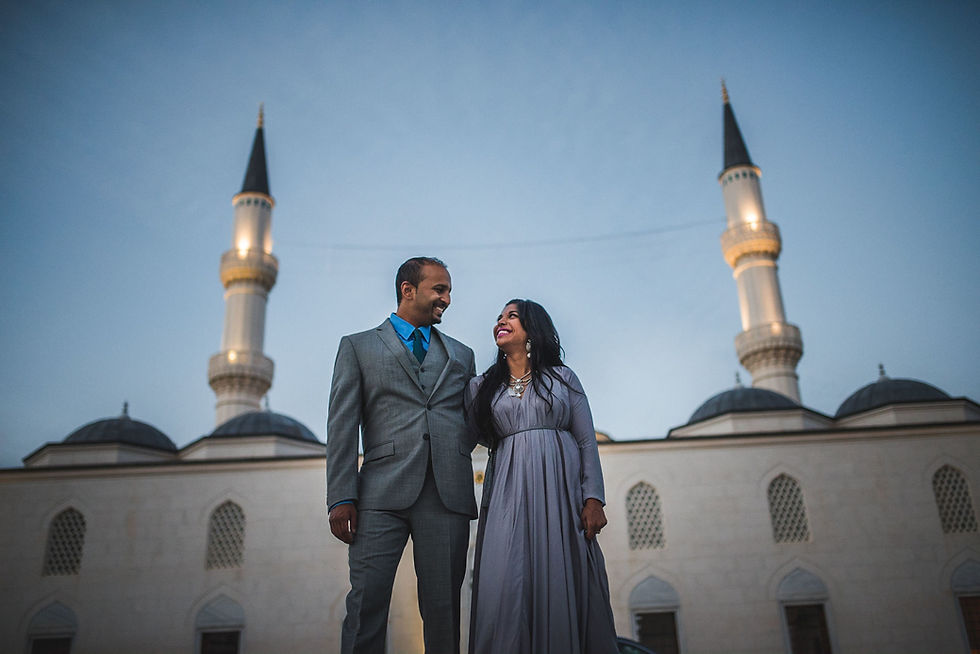
The photographs in this guide are an original couple portrait gallery by Mantas Kubilinskas. They show the exterior, architectural details, and different portrait compositions at Diyanet. They illustrate photography possibilities; they do not establish ceremony access or document a Nikah.
Confirm the ceremony and photography access first
DCA hosts Nikah ceremonies. Its official Nikah page lists the couple’s consent, two Muslim witnesses, and US-issued legal marriage documentation as minimum requirements. Confirm the current process and your arrangements directly with DCA before setting your schedule.
How do we reserve a Nikah date?
DCA directs couples to call 301-459-9589 for Nikah details and reservations. Ask about your date and ceremony arrangements directly with the center; photography coverage is booked separately. You can also use DCA’s official contact page.
Which spaces can we use for photographs?
Confirm the spaces and photography permissions for your booking with DCA. The official Nikah information confirms that the center hosts ceremonies; it does not specify photographer positions, flash permissions, or a guaranteed indoor portrait location.
Keep the ceremony booking and the photography plan in the same conversation. Ask the center:
Which spaces are available for your ceremony and portraits on your date?
Where may the photographer stand, and are flash or other lighting equipment permitted?
When can you arrive, and when must photography finish?
Are there access, attire, or privacy instructions you should pass to guests and vendors?
What indoor option, if any, is available if outdoor portraits become impractical?
These are planning questions, not a statement of DCA's policies. Do not assume that a portrait location pictured here is available for every booking. Confirm fees, guest capacity, reception arrangements, catering, and any vendor conditions directly with the center; this guide does not quote a wedding package or a preferred-vendor list.
Build the timeline around the Nikah and your family
Once the ceremony arrangements are confirmed, identify the moments that matter to you. Tell your photographer who should be included, which relationships deserve particular attention, and whether any moments should remain private. Share any guidance from the officiant before the day so the photographer can choose a position without interrupting the ceremony.
For family portraits, prepare a short list of groups using people's names. Ask someone who knows both families to help gather each group. Photograph relatives who need an easier route or a shorter wait early in the sequence. Plan a place for people to wait that keeps entrances clear.
Leave a separate period for portraits of the two of you. A schedule that treats family groups and couple portraits as one undifferentiated block makes it harder to give either the attention it deserves. The duration depends on the groups, walking distance, access, and the kind of photographs you want; agree on that with your photographer rather than copying a fixed timeline.
For more help deciding what belongs in your schedule, browse the wedding planning articles.
Use the architecture without losing the connection
The gallery offers several ways to photograph a couple in the same setting. A wide frame makes the building part of the story. A closer frame lets expressions and gestures lead. Alternating between them gives the location context without turning every portrait into an architectural photograph.

In this wide photograph, the couple is small against the facade. The curved outline and windows carry much of the composition. This kind of frame suits couples who want the setting to remain a strong part of their photographs.

The closer portrait changes the emphasis. The doorway supplies a quiet background, while the embrace and expression become the subject. You do not need the whole building in every photograph for the gallery to feel connected to Diyanet.

The pale wall gives this portrait room to breathe. The patterned windows establish the setting without competing with the couple. Simpler backgrounds can be useful when you want an uncluttered photograph of a face, a gesture, or an outfit.
Plan for the light and a weather alternative
The gallery includes exterior photographs in softer light and frames with illuminated architectural details. That variety is useful inspiration, but it is not a promise that the same conditions will be available on your date. Ask your photographer how the timing of your ceremony affects the outdoor portrait options.
If you want an exterior photograph that includes the building, allow time to reach the agreed location and compose it. If you prefer quieter, closer portraits, discuss sheltered or simpler backgrounds as well. Avoid committing the entire portrait plan to one outdoor position.
Ask DCA about a weather alternative before the day. A doorway appearing in a photograph does not mean it is an approved rain plan. Confirm which areas can be used, how people will move between them, and whether a separate reception location needs its own photography plan.
Arrange guest travel to Lanham
Give guests the Lanham address rather than a general Washington, DC label. Guests staying in DC should plan travel to the center separately from their hotel itinerary. Avoid promising a fixed journey time; their starting point, date, and traffic will affect it.
Confirm parking, drop-off arrangements, accessible routes, and the meeting point with DCA. If your celebration continues at another location, include that address and the transfer plan in your schedule. Those details matter to the photographer too: moving between venues reduces the time available for portraits.
Original Diyanet couple portrait gallery
These remaining photographs by Mantas Kubilinskas show how movement, detail, and a change in scale can add variety to one location.




If you are considering portraits separately from your wedding day, the engagement photography articles offer more examples of couple sessions.
Talk through your photography plan
When you contact Mantas about photography, share your date, your confirmed DCA arrangements, your ceremony timing, and any family or privacy priorities. That gives us a useful starting point for discussing coverage and portraits.
You can also view Mantas’s wedding photography to see more of the work.
Confirm the venue booking with DCA separately from photography coverage.
About the photographer: Mantas Kubilinskas is the photographer behind this gallery and the wedding photographs linked above. The planning advice here combines the visible portrait examples with DCA's official venue and Nikah information, checked on October 2, 2026. Availability and access should be reconfirmed for your booking.